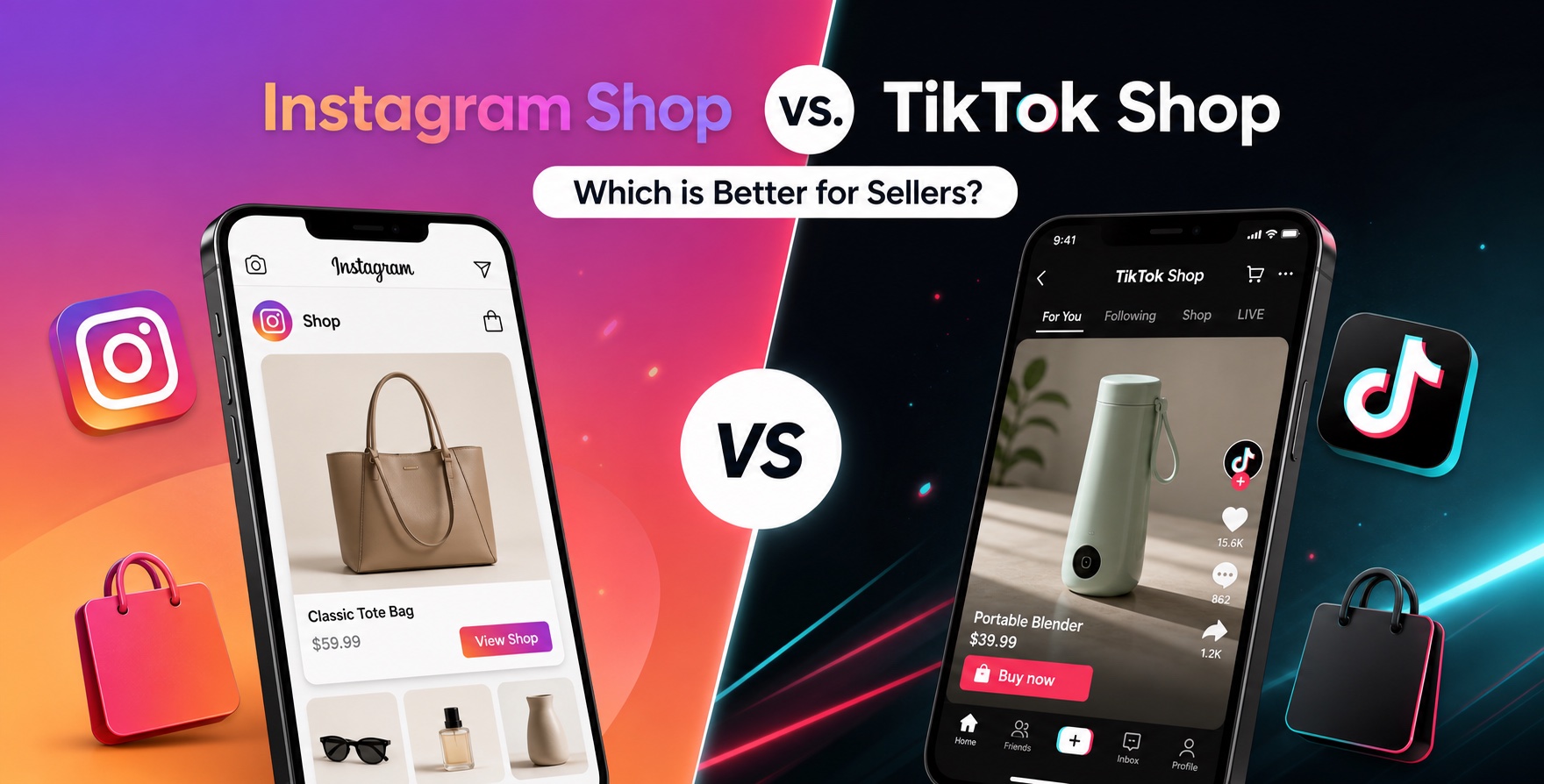
Selling on Instagram and using the TikTok Shop are two models that might fit your business. You need to know which one is the right fit for you so you can better manage your time and effort.

How to Tell If an Instagram Post Is AI-Generated
An explicit disclosure or Instagram's AI info label is one of the clearest clues available, but it answers a narrower question than many people assume: did the upload carry a recognized AI signal or disclosure? It does not establish that the entire image was generated. No label leaves the image's origin unknown.
Check the AI info label first
Look near the photo or video for an AI info label and open it for more detail. If you do not see one, check the post's options menu. Placement depends on what the label indicates: a post identified as AI-generated may carry a visible label, while one identified as modified with AI may show it in the menu instead.
This marker can come from industry-standard information embedded in a file or from the uploader disclosing AI use. Read it as a provenance clue, not a full edit history: it may not identify the exact tool or explain how much of the image changed.

An AI label doesn't always mean the whole image is synthetic
“Made with AI” was replaced by “AI info” after minor retouching triggered the stronger-sounding label. The distinction matters: a fully synthesized composition is not the same as a camera original with a single algorithmic alteration.
Visual clues can raise a question, not settle it
When a post has no label, inspect details generative tools can mishandle: warped lines or backgrounds, text and logos that do not quite make sense, and surfaces that look unnaturally smooth. Several oddities are a reason to look closer, not proof of AI.
Such artifacts are fallible. A real image can look strange after retouching or compression, while a convincing generated image may show no obvious flaw. Avoid calling a picture AI-made based on one distorted detail or an uncanny impression.
Weigh the clues in order
Start with the strongest available evidence: an explicit disclosure or Instagram's label details. Next, compare the image with its caption, the account's other posts, and any earlier version you can find. A reverse-image search can help locate copies or older versions; it cannot establish which edits were made or prove that an image was generated.
Treat visual oddities as the weakest signal. If the post makes an important claim about a real event, look for independent coverage or other images of that event before sharing it as authentic. For a casual meme, that level of checking may not matter; for news or public safety, it does.
If you create AI posts, lead with something useful
Simply turning an AI-generated image into a video may not give viewers a strong reason to keep watching. For informational posts, test a carousel: keep each slide focused on one concise point, give people a reason to swipe, and make the first slide promise a specific takeaway.
The image itself can draw attention, but practical value gives people a reason to save or follow. Show a tool, prompt, or workflow someone can try, or explain how it saves time. Study how successful creators in your niche open their posts and solve problems, then adapt the pattern instead of copying their content. Treat format choices as experiments for your own account, not a guarantee that carousels will outperform videos.
What if there's no label?
Treat the absence of AI info as inconclusive. Labeling depends on signals in the file or a disclosure, and the system is still evolving; some AI-edited content may not be labeled. A missing badge cannot establish that a post is camera-original or free of AI changes.
When the evidence remains mixed, describe what is visible rather than guessing how the image was made. “The photo appears edited” is more accurate than “This is AI-generated” when all you have is an unusual-looking background and no label or context.
Related Posts
Things have changed quite a lot—mostly due to the beauty niche becoming super saturated with a ton of influencers. That doesn't mean there's no entry into this. But you do have to shift your perspective a bit.
Using Instagram on a public WiFi comes with its own set of nuances. Can Instagram run smoothly over a VPN to view content from other countries? Does Instagram/Meta detect VPN use and penalize it?
The site is a fan page. Insnoop is not connected with Instagram. All content belongs to the content authors. Download is available for informational purposes only.
InSnoop