logoInSnoop
Home
Blog
BLOG

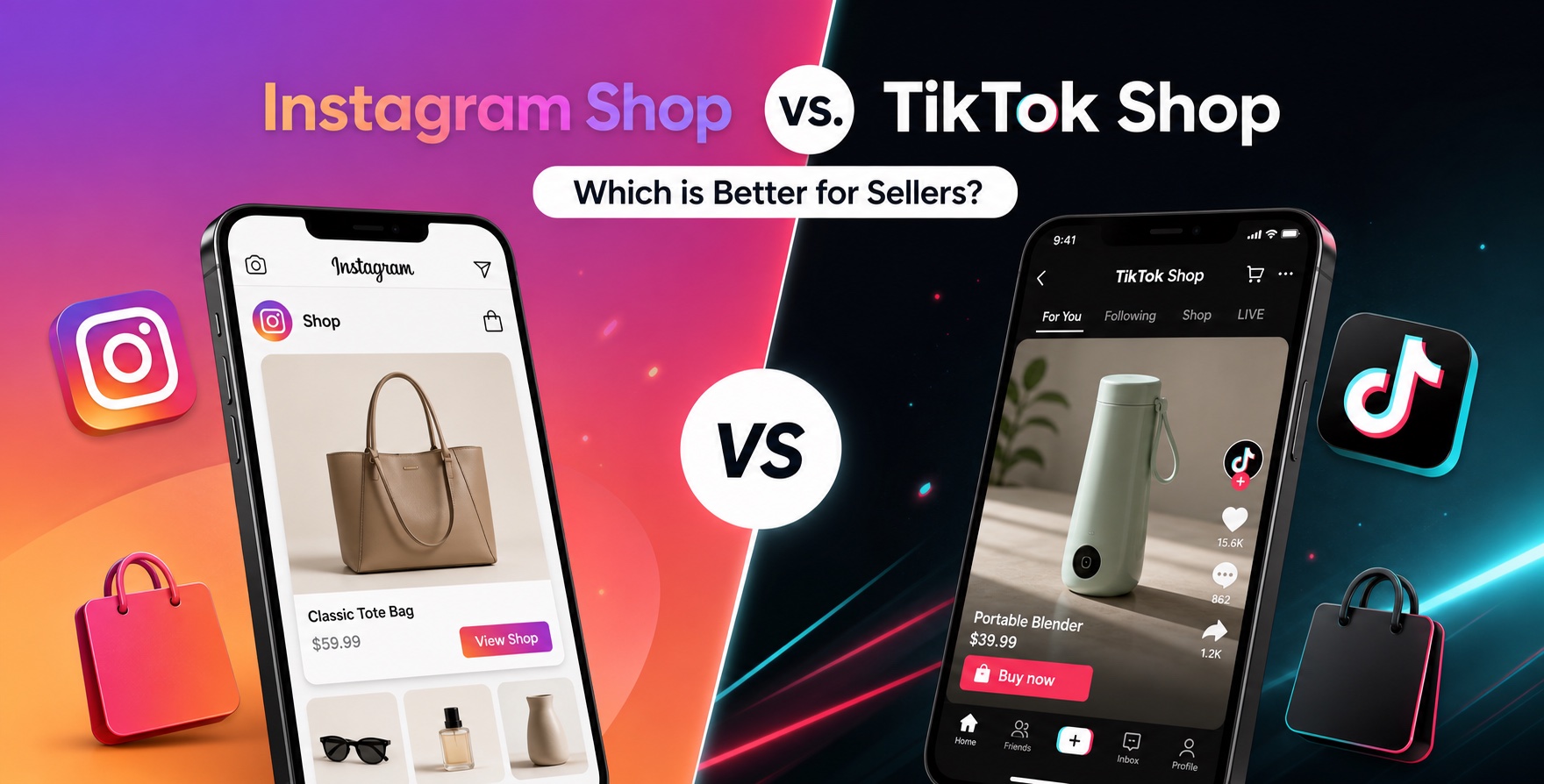
Instagram Shop vs. TikTok Shop: Which is Better for Sellers?

Selling on Instagram and using the TikTok Shop are two models that might fit your business. And most importantly, you need to know which one is the right fit for you so you can better manage your time and effort.

A quick note before we move on. Instagram has deprecated the native “Shop” feature it had, allowing people to sell items directly on the platform. Meta wound down native in-app checkout on Instagram (US merchants transitioned off by mid-2025, fully deprecated by around August 2025), and the Shop tab was deprecated in many regions before that. So Instagram is now a discovery-and-traffic channel that hands buyers off to your own site, while TikTok Shop is a full transactional marketplace with checkout inside the app.

The question here, therefore, isn't about which storefront will convert better. It's about which model of doing business suits you. When you first start diving down this rabbit hole, you'll find a lot of publications still treating this debate as pre-2022, as in literally comparing the Instagram native shop features with TikTok's. Needless to say, that's a waste of time because the feature simply doesn't exist anymore.

Alright, now with that out of the way, let's focus on what Instagram gives sellers in 2026. We'll then move on to what TikTok gives you (and where it works wonders). Lastly, we'll compare the two platforms. When laid out that way, by the end of this article, you'll already know (way better than we ever could) precisely which platform is the best for your business, startup, or hobby.

What Instagram Shop Actually Gives Sellers in 2026

Product tagging works in feed posts, Reels, and Stories. A shopper taps the tag, sees product details inside Instagram, then gets routed to your own site to buy. Instagram is the catalog and the traffic source. However, it is not a checkout. It must still direct all that traffic and attention to a different platform—like your website or online store. And the final conversion success rate depends on the whole thing, not just Instagram. So, double optimization is needed, which also doubles your effort (some will argue that optimizing a full website for sales is more complex than optimizing an Instagram feed, so perhaps more than double the effort).

That might sound like a bad deal, but it's not. There's no commission you must pay to Meta! Of course, you pay your own ecommerce platform's costs (could be hosting costs for self-hosted WooCommerce/WordPress, transaction or processing fees for online storefronts, subscriptions and commissions for Shopify, etc.). But those are typically lower than what a marketplace takes. The old 5% selling fee era is over.

Plus, you own the customer. Okay, that sounds a little ultra-capitalist. But here's what we mean—you have it all. Starting right from the email, purchase history, and browsing behavior to post-purchase relationship, interaction heatmap with analytics tools, search intent knowledge with SEO tools, etc. It's all there. With you. And the sky's the limit to what you can do with all the data.

We'll not be transforming this article into a guide for that. But over time, you'll naturally learn about a bunch of stuff, like how to tie coupon codes to abandoned carts, how to find topics to improve organic traffic, how to make the checkout process smoother, to whom to show what pop-up and when, etc.

For example, if you don't even know the average time a customer spends on your “Summer Bestsellers” landing page, for example, how can you plan a pop-up? It would just be a nuisance. But armed with the right data and analytics, you can shape your platform to be a rockstar in selling—albeit not overnight. On a marketplace, that data belongs to the platform. Whether it's a TikTok shop or an Etsy store.

The lack of commission + having your own data is already a good package. But there's more that Instagram gives you:

  • Instagram's economics skew differently. The reported average order values tend to run higher than TikTok's, while conversion rates run lower. Instagram is a considered-purchase channel more than an impulse channel.
  • Instagram's real product-research value is that it tells you what people want before they buy. Watch which of your existing posts get saves and profile visits without any promotion behind them. Watch what shows up repeatedly in your DMs and comments as “where is this from” or “is this still available.” See what competitors are selling out of and back-ordering constantly. All this helps you nail down the art of finding winning products from Instagram.
  • Shoppable posts reportedly out-engage non-shoppable ones, and product tags in Reels outperform tags in carousels

What TikTok Shop Gives Sellers

The checkout happens inside the app, within the feed, and that's a level of seamlessness that's sufficient to make many business owners flock to TikTok instead of Instagram. Discovery, demonstration, and purchase compress into a single moment, which is why impulse-friendly products do disproportionately well there.

Also, TikTok's scale is real. The TikTok Shop's global GMV roughly doubled in 2025 and is projected to climb steeply throughout 2026.

Over here, the main engine is the affiliate marketplace. Sellers set a commission rate at the product level, creators browse and self-select to promote it, and you pay only on confirmed sales. But keep in mind that a small handful of creators drive the overwhelming majority of sales.

And let's not forget the shipping angle. TikTok mandated its own fulfillment service for US sellers in most categories as of March 2026, which removes shipping as a lever you control.

But there's the fee. The 6%-ish referral fee is the entry price. Add affiliate commission (often 10-30%, higher in beauty), fulfillment, ad spend, and returns, and the all-in platform take commonly lands somewhere in the 35%+ range of GMV before you've paid for the product itself.

What Actually Affects Whether a Reel Trends

Let's take a look at Instagram's 2026 signals.

  • Instagram's 2026 “Originality Score” actively suppresses Reels carrying a visible TikTok or CapCut watermark. It's the one place editor choice can directly tank reach.
  • CapCut's free tier is watermark-free for normal edits, but certain AI features/Pro-only templates and effects still stamp a watermark if used without a paid plan. Free users need to double-check exports before uploading.
  • Canva's free plan exports no-watermark videos at 1080p. This is a point in Canva's favor.
  • Neither tool's brand/logo is the issue by itself. It's specifically leftover platform watermarks (TikTok logo, editor logos) that get penalized. Native, unbranded exports from either tool are treated equally by the algorithm.
  • 1080x1920 (9:16), high-resolution videos with clean audio should be your default.
  • Reels up to 3 minutes are now eligible for non-follower distribution, but completion rate still rules. The editing feature that arguably matters most for trending isn't a fancy effect, it's whichever app gets a strong hook into the first 3 seconds fastest.
  • Good editing certainly makes content more watchable but it doesn't substitute for a strong hook. The algorithm still values Instagram's core signals (watch time, DM shares, and saves).

Instagram Shop vs. TikTok: The Final Verdict

There's a bunch of stuff on TikTok Shop that Instagram simply lacks (as it's not a native shop-like experience anymore and is more of a catalog or traffic source). This includes in-app checkout (more seamless), an affiliate marketplace, and mandated shipping. But all this costs. As we saw above, it could cost you over 35% of the product's own cost.

With Instagram, you don't get that. Not even the costs

  • TikTok Shop buys you conversion and distribution but rents you the customer and taxes the transaction. Instagram gives you the customer, the data, and the margin, but makes you supply the conversion infrastructure yourself.
  • TikTok is preferred for impulse-priced products (US data points to roughly the $30 to 60 range converting best), products that demo well on camera, products that unbox well, and categories where you have margin to absorb a double-digit affiliate commission. If your gross margin can't survive a 15-25% commission plus 6% referral plus ad spend, the math doesn't work.
  • Instagram is preferred for higher-ticket and considered purchases, brand-led businesses that need to own the customer relationship, and anyone who already has a functioning store with a good mobile checkout.

Every tap between the product tag and the completed purchase is a drop-off point, and Instagram now has more of them than TikTok does. Most serious sellers don't pick. They use TikTok Shop for velocity and impulse SKUs and Instagram for brand, margin, and customer ownership. Our advice? Don't ask “which platform?” Ask “which of my products belongs on which?”


Related Posts

Become a Beauty Content Creator on Instagram

Things have changed quite a lot—mostly due to the beauty niche becoming super saturated with a ton of influencers. That doesn't mean there's no entry into this. But you do have to shift your perspective a bit.

How to Use Instagram Safely on Public WiFi and VPN

Using Instagram on a public WiFi comes with its own set of nuances. Can Instagram run smoothly over a VPN to view content from other countries? Does Instagram/Meta detect VPN use and penalize it?

CapCut vs. Canva for Instagram: How to Make Trending Reels?

In this guide, we're going to tell you precisely which one works well for what type of content—with results you can measure and verify yourself from Day 1!

  • Blog
  • Privacy Policy
  • Terms And Condition
  • Contact Us

The site is a fan page. Insnoop is not connected with Instagram. All content belongs to the content authors. Download is available for informational purposes only.